
Welcome to the PayCheck Customer Hub
This Customer Hub is designed for authorised payroll contacts from our client organisations. Employees should contact their employer’s HR/Payroll team for any personal payroll queries.

Our Portal Guide
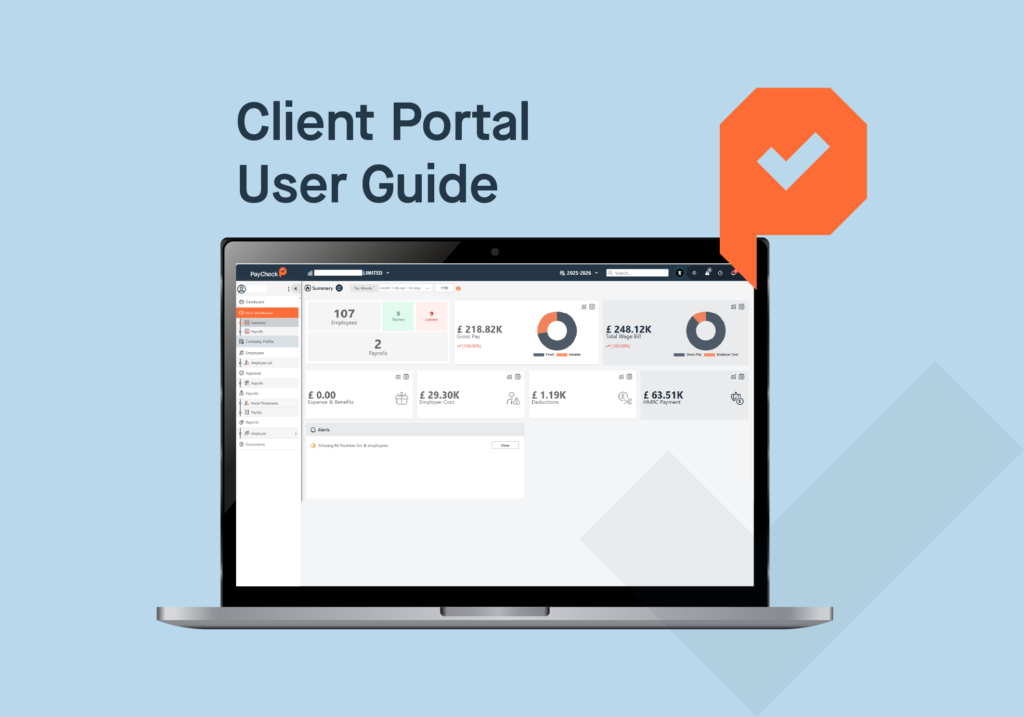
Client Portal Guide
The client portal is user friendly and allows for secure data transfer within our payroll software
system.
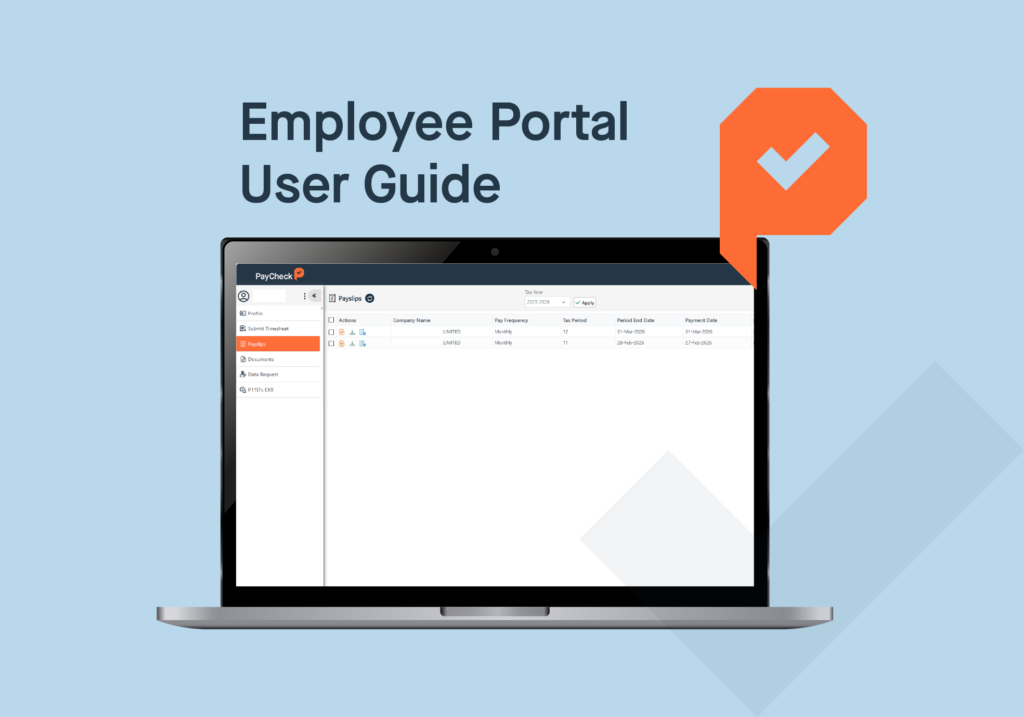
Employee Portal User Guide
This guide will assist you in navigating our employee portal, which are fully accessible on mobile
and tablet devices.
Statutory Information
Pay Date & Submission Timetable
Guide to when to submit your payroll according to your pay date.
National Minimum Wage
The National Minimum Wage is the minimum pay per hour almost all workers are entitled to by law. Find out more about who can get the minimum wage.
Use the National Minimum Wage calculator to check if you’re paying a worker the National Minimum Wage or if you owe them payments from past years.
These rates apply from 1 April 2026.
Category of worker | Hourly rate |
Aged 21 and above (national living wage rate) | £12.71 |
Aged 18 to 20 inclusive | £10.85 |
Aged under 18 (but above compulsory school leaving age) | £8.00 |
Apprentices aged under 19 | £8.00 |
Apprentices aged 19 and over, but in the first year of their apprenticeship | £8.00 |
Statutory Sick Pay
The weekly rate of Statutory Sick Pay (SSP) for 2026 to 2027 is £123.25 or 80% of the employee’s average weekly earnings, whichever is lower.
The amount of SSP you must pay an employee for each day they’re off work from the first day of illness (the daily rate) depends on the:
- employee’s average weekly earnings
- number of ‘qualifying days’ they work each week
A daily rate will apply either based on the standard weekly rate or will be specific to the employee. The SSP daily rates and amounts to pay in the tables are based on the standard weekly rate.
Use the Statutory Sick Pay calculator to work out your employee’s sick pay, or read how to work out your employee’s Statutory Sick Pay manually using these rates.
(you no longer need to be off for 4 days in a row, SSP is paid from day 1)
Unrounded daily rates | Number of qualifying days in week | 1 day to pay | 2 days to pay | 3 days to pay | 4 days to pay | 5 days to pay | 6 days to pay | 7 days to pay |
£16.6785 | 7 | £17.61 | £35.22 | £52.83 | £70.43 | £88.04 | £105.65 | £123.25 |
£19.4583 | 6 | £20.55 | £41.09 | £61.63 | £82.17 | £102.71 | £123.25 | |
£23.35 | 5 | £24.65 | £49.30 | £73.95 | £98.60 | £123.25 | ||
£29.1875 | 4 | £30.82 | £61.63 | £92.44 | £123.25 | |||
£38.9166 | 3 | £41.09 | £82.17 | £123.25 | ||||
£58.375 | 2 | £61.63 | £123.25 | |||||
£116.75 | 1 | £123.25 |
Student Loan & Postgraduate Loan Recovery
If your employees’ earnings are above the earnings threshold, we record their student loan and postgraduate loan deductions in our payroll software. It will automatically calculate and deduct repayments from their pay.
Rate or threshold | 2026 to 2027 rate |
Employee earnings threshold for student loan plan 1 | £26,900 per year |
Employee earnings threshold for student loan plan 2 | £29,385 per year |
Employee earnings threshold for student loan plan 4 | £33,795 per year |
Employee earnings threshold for student loan plan 5 | £25,000 per year |
Student loan deductions | 9% |
Employee earnings threshold for postgraduate loan | £21,000 per year |
Postgraduate loan deductions | 6% |
Tax Thresholds
Tax thresholds, rates and codes
England and Northern Ireland
PAYE tax rates and thresholds | 2026 to 2027 |
Employee personal allowance | £242 per week |
English and Northern Irish basic tax rate | 20% on annual earnings above the PAYE tax threshold and up to £37,700 |
English and Northern Irish higher tax rate | 40% on annual earnings from £37,701 to £125,140 |
English and Northern Irish additional tax rate | 45% on annual earnings above £125140.00 |
Scotland
PAYE tax rates and thresholds | 2026 to 2027 |
Employee personal allowance | £242 per week |
Scottish starter tax rate | 19% up to £3,967 |
Scottish basic tax rate | 20% from £3,968 to £16,956 |
Scottish intermediate tax rate | 21% from £16,957 to £31,092 |
Scottish higher tax rate | 42% from £31,093 to £62,430 |
Scottish Advanced tax | 45% from £62,431 to £125,140 |
Scottish Top tax rate | 48% Above £125,140. |
Wales
PAYE tax rates and thresholds | 2026 to 2027 |
Employee personal allowance | £242 per week |
Welsh basic tax rate | 20% up to £37,700 |
Welsh higher tax rate | 40% from £37,701 to £125,140.00 |
Welsh additional tax rate | 45% above £125,140.00 |
Income Tax rates and thresholds are subject to parliamentary approval.
Emergency tax codes
The emergency tax codes from 6 April 2026 are:
- 1257L W1
- 1257L M1
- 1257L X
Find out more about emergency tax codes.
National Insurance rates
Class 1 National Insurance thresholds | 2026 to 2027 |
Lower earnings limit | £129 per week |
Primary threshold | £242 per week |
Secondary threshold | £96 per week |
Freeport upper secondary threshold | £481 per week £2083 per month £25000 per year |
Investment Zone upper secondary threshold | £481 per week |
Upper secondary threshold (under 21) | £967 per week |
Apprentice upper secondary threshold (apprentice under 25) | £967 per week |
Veterans upper secondary threshold | £967 per week |
Upper earnings limit | £967 per week |
Class 1 National Insurance rates
Employee (primary) contribution rates
Deduct primary contributions (employee’s National Insurance) from your employees’ pay through PAYE.
National Insurance category letter | Earnings at or above lower earnings limit up to and including primary threshold | Earnings above the primary threshold up to and including upper earnings limit | Balance of earnings above upper earnings limit |
A | 0% | 8% | 2% |
B | 0% | 1.85% | 2% |
C | nil | nil | nil |
D (Investment Zone — deferment) | 0% | 2% | 2% |
E (Investment Zone — married women and widows reduced rate) | 0% | 1.85% | 2% |
F (Freeport) | 0% | 8% | 2% |
H (apprentice under 25) | 0% | 8% | 2% |
I (Freeport – married women and widows reduced rate) | 0% | 1.85% | 2% |
J | 0% | 2% | 2% |
K (Investment Zone — state pensioner) | Nil | Nil | Nil |
L (Freeport – deferment) | 0% | 2% | 2% |
M (under 21) | 0% | 8% | 2% |
N (Investment Zone) | 0% | 8% | 2% |
S (Freeport – state pensioner) | Nil | Nil | Nil |
V (veteran) | 0% | 8% | 2% |
Z (under 21 – deferment) | 0% | 2% | 2% |
Employer (secondary) contribution rates
You pay secondary contributions (employer’s National Insurance) to HMRC as part of your PAYE bill.
Pay employers’ PAYE tax and National Insurance.
National Insurance category letter | Earnings at or above lower earnings limit up to and including secondary threshold | Earnings above secondary threshold up to and including Freeport upper secondary threshold | Earnings above Freeport upper secondary threshold up to and including upper earnings limit, upper secondary thresholds for under 21s, apprentices and veterans | Balance of earnings above upper earnings limit, upper secondary thresholds for under 21s, apprentices and veterans |
A | 15% | 15% | 15% | 15% |
B | 15% | 15% | 15% | 15% |
C | 15% | 15% | 15% | 15% |
D (Investment Zone — deferment) | 0% | 0% | 15% | 15% |
E (Investment Zone — married women and widows reduced rate) | 0% | 0% | 15% | 15% |
F (Freeport) | 0% | 0% | 15% | 15% |
H (apprentice under 25) | 0% | 0% | 0% | 15% |
I (Freeport — married women and widows reduced rate) | 0% | 0% | 15% | 15% |
J | 15% | 15% | 15% | 15% |
K (Investment Zone — state pensioner) | 0% | 0% | 15% | 15% |
L (Freeport — deferment) | 0% | 0% | 15% | 15% |
M (under 21) | 0% | 0% | 0% | 15% |
N (Investment Zone) | 0% | 0% | 15% | 15% |
S (Freeport — state pensioner) | 0% | 0% | 15% | 15% |
V (veteran) | 0% | 0% | 0% | 15% |
Z (under 21 — deferment) | 0% | 0% | 0% | 15% |
Class 1A National Insurance: expenses and benefits
You must pay Class 1A National Insurance on work benefits you give to your employees, for example a company mobile phone. You report and pay Class 1A on expenses and benefits at the end of each tax year.
The National Insurance Class 1A rate on expenses and benefits for 2026 to 2027 is 15%.
Find out more about expenses and benefits for employers.
Class 1A National Insurance: termination awards and sporting testimonial payments
Class 1A National Insurance contributions are due on the amount of termination awards paid to employees which are over £30,000 and on the amount of sporting testimonial payments paid by independent committees which are over £100,000. You report and pay Class 1A on these types of payments during the tax year as part of your payroll.
The National Insurance Class 1A rate on termination awards and sporting testimonial payments for 2026 to 2027 is 15%.
Statutory Pay and Leave
Statutory Maternity, Paternity, Adoption, Shared Parental and Parental Bereavement Pay
Use the maternity, adoption and paternity calculator for employers to work out your employee’s:
- Statutory Maternity Pay (SMP)
- paternity or adoption pay
- qualifying week
- average weekly earnings
- leave period
These rates apply from 5 April 2026.
Type of payment or recovery | 2026 to 2027 rate |
Statutory Maternity Pay — | 90% of the employee’s average weekly earnings |
Statutory Maternity Pay— | £194.32 or 90% of the employee’s average weekly earnings, whichever is lower |
Statutory Paternity Pay (SPP) — | £194.32 or 90% of the employee’s average weekly earnings, whichever is lower |
Statutory Adoption Pay (SAP) — | 90% of the employee’s average weekly earnings |
Statutory Adoption Pay (SAP) — | £194.32 or 90% of the employee’s average weekly earnings, whichever is lower |
Statutory Shared Parental Pay (ShPP) — weekly rate | £194.32 or 90% of the employee’s average weekly earnings, whichever is lower |
Statutory Parental Bereavement Pay (SPBP) — weekly rate | £194.32 or 90% of the employee’s average weekly earnings, whichever is lower |
Statutory Neonatal Care Pay (SNCP) — weekly rate | £194.32 or 90% of the employee’s average weekly earnings, whichever is lower |
SMP, SPP, ShPP, SAP, SPBP or SNCP — | 92% if your total Class 1 National Insurance (both employee and employer contributions) is above £45,000 for the previous tax year 109% if your total Class 1 National Insurance for the previous tax year is £45,000 or lower |
Company Car & Mileage Rates
Company cars: advisory fuel rates
Use advisory fuel rates to work out mileage costs if you provide company cars to your employees.
These rates apply from 1 March 2026.
Engine size | Petrol — amount per mile | LPG — amount per mile |
1400cc or less | 12 pence | 10 pence |
1401cc to 2000cc | 14 pence | 12 pence |
Over 2000cc | 22 pence | 19 pence |
Engine size | Diesel — amount per mile |
1600cc or less | 12 pence |
1601cc to 2000cc | 13 pence |
Over 2000cc | 18 pence |
Hybrid cars are treated as either petrol or diesel cars for this purpose.
Check advisory fuel rates for previous periods.
Advisory electricity rate for fully electric cars from 1 March 2026
Charging location | Electric — amount per mile |
Home charger | 7 pence |
Public charger | 15 pence |
Electricity is not a fuel for car fuel benefit purposes.
Employee vehicles: mileage allowance payments
Mileage allowance payments are what you pay your employees for using their own vehicle for business journeys.
You can pay your employees an approved amount of mileage allowance payments each year without having to report them to HMRC. To work out the approved amount, multiply your employee’s business travel miles for the year by the rate per mile for their vehicle.
Find out more about reporting and paying mileage allowance payments.
Type of vehicle | Rate per business mile 2026 to 2027 |
Car | For tax purposes — 45 pence for the first 10,000 business miles in a tax year, then 25 pence for each subsequent mile For National Insurance purposes — 45 pence for all business miles |
Motorcycle | 24 pence for both tax and National Insurance purposes and for all business miles |
Cycle | 20 pence for both tax and National Insurance purposes and for all business miles |
Employment Allowance & Apprenticeship Levy
Employment Allowance allows eligible employers to reduce their annual National Insurance liability by up to the annual allowance amount.
Allowance 2026 to 2027 rate
Employment Allowance £10,500.00
Apprenticeship Levy
Employers and connected companies with a total annual pay bill of more than £3 million, are liable to the Apprenticeship Levy, which is payable monthly. Employers who are not connected to another company or charity will have an annual allowance that reduces the amount of Apprenticeship Levy you have to pay. Apprenticeship Levy is charged at a percentage of your annual pay bill.
Allowance or charge | 2026 to 2027 rate |
Apprenticeship Levy allowance | £15,000 |
Apprenticeship Levy charge | 0.5% |
Points of Interest (Additional information on Carers Allowance, Tronc Payroll and Apprenticeship Levy.)
Apprenticeship Levy
Employers and connected companies with a total annual pay bill of more than £3 million, are liable to the Apprenticeship Levy, which is payable monthly. Employers who are not connected to another company or charity will have an annual allowance that reduces the amount of Apprenticeship Levy you have to pay. Apprenticeship Levy is charged at a percentage of your annual pay bill.
Allowance or charge | 2026 to 2027 rate |
Apprenticeship Levy allowance | £15,000 |
Apprenticeship Levy charge | 0.5% |
Speak to us
Our team is on hand to help with any questions, suggestions and feedback. This enquiry for is only for PayCheck employers only.
Employees: If you work for one of our client organisations, please speak to your employer regarding payroll queries.
Employees: If you work for one of our client organisations, please speak to your employer regarding payroll queries.